Caravan Towing Weights Explained: The Numbers That Actually Matter Before You Hit the Road
If you’re planning to tow a caravan around Australia, there’s a wall of acronyms standing between you and the open road: GVM, ATM, GCM, TBM, GTM, Tare, Kerb Weight. It reads like alphabet soup, and most dealership brochures don’t make it any clearer. But here’s the thing—understanding caravan towing weights isn’t bureaucratic nonsense. These numbers are the difference between a safe, legal setup and one that could land you with a defect notice, void your insurance, or worse.
This guide cuts through the marketing fluff and explains what each figure actually means, why the “maximum towing capacity” plastered across car advertisements is often meaningless in practice, and how to work out whether your rig will genuinely handle the trip you’re planning.
Why Caravan Towing Weights Matter
Before we get into the alphabet soup of acronyms, it’s worth understanding why these numbers matter so much. Exceeding your caravan towing weights isn’t just a technical breach—it has real consequences that can ruin your trip, your finances, or your life.
Safety: Physics Doesn’t Care About Your Plans
An overloaded rig behaves differently from a properly weighted one. Braking distances increase dramatically—that extra few hundred kilograms might be the difference between stopping safely and rear-ending the car in front. Steering becomes sluggish and imprecise. On downhill stretches, an overweight combination can quickly become uncontrollable, especially if the brakes overheat and fade.
Then there’s sway. When a caravan is too heavy, poorly balanced, or exceeds the tow vehicle’s capability, it becomes prone to dangerous lateral oscillation. What starts as a gentle wobble can escalate into a violent pendulum effect in seconds, especially when triggered by a gust of wind, an overtaking truck, or a slight steering correction. Recovering from a serious caravan sway is difficult even for experienced drivers—and at highway speeds, it can be impossible.
Insurance: The Fine Print That Bites
Here’s a scenario nobody wants to face: you’re involved in an accident, and the assessor discovers your rig was overloaded. Your insurer can—and likely will—deny your claim. It doesn’t matter that you’ve paid your premiums for years. Exceeding manufacturer weight limits is considered negligence, and most policies exclude vehicles operated outside legal specifications.
This applies to both your vehicle insurance and your caravan insurance. If your overloaded setup causes damage to someone else’s property or injures another person, you could be personally liable for costs that run into the hundreds of thousands.
Legal Requirements: Defects, Fines, and Grounded Rigs
Every state and territory in Australia has roadworthiness laws, and weight limits are enforceable. Police and transport inspectors conduct random weighbridge checks, particularly on major touring routes and during holiday periods. If your rig exceeds its limits, you may be issued a defect notice on the spot.
A defect notice means you’re not going anywhere until the vehicle is compliant. That might mean unloading gear on the side of the road, arranging alternative transport for excess weight, or, in serious cases, having the vehicle towed. Fines vary by state but can run into thousands of dollars for significant breaches. Repeat offenders or those involved in accidents while overloaded face even harsher penalties.
Vehicle Damage: Wearing Out Your Rig
Even if you avoid accidents and inspections, running an overloaded setup takes a toll on your equipment. Brakes wear faster and run hotter. Suspension components fatigue and fail prematurely—expect blown shocks, cracked springs, and worn bushes. Transmissions and drivetrains work harder, leading to overheating and accelerated wear. Tyres run hotter and are more prone to blowouts, particularly on long stretches of hot bitumen.
The cumulative damage from sustained overloading can slash the lifespan of your tow vehicle and caravan. What should last a decade of touring might need major repairs—or replacement—after just a few years. The money you thought you saved by not upgrading to a proper setup ends up spent on mechanics instead.
The Golden Rule: Decide on the Van First, Then the Car
Before diving into the specifics of caravan towing weights, let’s establish one fundamental principle that will save you money and heartache: if you haven’t bought your setup yet, choose the caravan first.
Too many people do it backwards. They buy the 4WD they’ve always wanted, then try to find a caravan that “fits” within its towing capacity. The result is usually disappointment—either settling for a van that’s smaller than what the family needs, or discovering that the dream car can’t legally or safely pull anything substantial once you factor in passengers, gear, and a full fuel tank.
Work out what you need in a caravan: how many berths, layout, off-road capability, length, and, importantly, weight. Only then do you shop for a tow vehicle that can genuinely handle it—not based on the hero number in the brochure, but on the actual maths of real-world towing.
The “Hero Number” Trap: Why Maximum Towing Capacity Is Marketing, Not Reality
You’ve seen the advertisements: “Tows up to 3,500 kg!” Sounds impressive. It’s also, in most practical situations, complete rubbish.
That maximum towing capacity figure is tested under laboratory conditions—essentially a driver-only scenario with minimal fuel and no gear in the vehicle. The moment you add a second person, fill the fuel tank, throw in recovery gear, food, water, clothes, and maybe the dog, that headline number becomes irrelevant.
The real constraint on caravan towing weights isn’t maximum towing capacity. It’s the Gross Combination Mass (GCM), and understanding this figure is where many new towers come unstuck.
The GCM Equation: Why the Maths Often Doesn’t Work
Gross Combination Mass (GCM) is the maximum legal weight of your car and van combined. In most cases, Car GVM + Caravan ATM < GCM (we will shortly explain these numbers). You have to “give somewhere to get somewhere.” As an example, we’ll use a hypothetical vehicle with a GCM of 6,000 kg.
Table: The 3.5-Tonne Towing Myth
| Weight Component | Realistic Touring Setup | The “Marketing” Setup |
| Vehicle Weight (Loaded) | 3,200 kg (Full GVM) | 2,500 kg (Empty + Driver) |
| Caravan Weight (Loaded) | 2,800 kg (Safe ATM) | 3,500 kg (Max Capacity) |
| Total Combined (GCM) | 6,000 kg (LEGAL) | 6,000 kg (LEGAL) |
| Result | Full Car + Mid Van | Empty Car + Heavy Van |
As shown above, if you want to tow that 3,500 kg “maximum” while your car is loaded for a trip, you will almost certainly exceed the GCM. You effectively have to choose: a heavy van or a loaded car. You can rarely have both. With the marketing setup, you’ll be leaving the beer and the misses at home.
The Tow Vehicle: Understanding Your “Tug”
Every vehicle has a set of weight ratings stamped on its compliance plate. These are legal limits set by the manufacturer—exceed them, and you’re unroadworthy, uninsured, and potentially dangerous. Getting your head around these figures is the first step to understanding caravan towing weights properly.
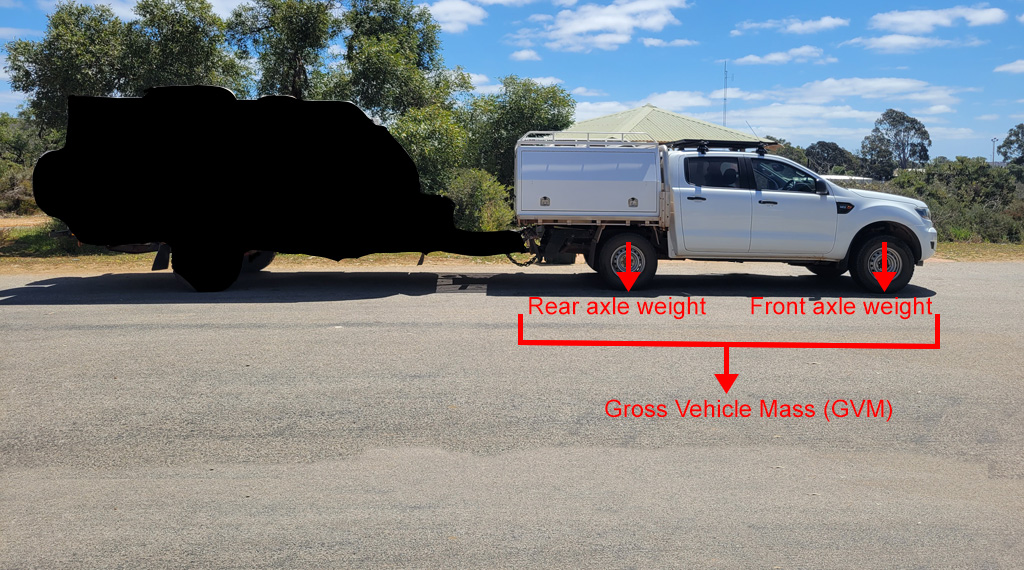
The image below illustrates the vehicle weights. Near the end of the page, we put everything together.
Kerb Weight
- Definition: The weight of the vehicle as it leaves the factory, including a full tank of fuel and all standard fluids, but with no passengers, no cargo, and no accessories.
- Why it matters: This is your baseline. Every bull bar, roof rack, dual-battery system, long-range fuel tank, and drawer system you add eats into your available payload.
Gross Vehicle Mass (GVM)
- Definition: The maximum the vehicle is legally allowed to weigh when in use—including everything: fuel, passengers, cargo, accessories, and the ball weight of the caravan pushing down on the tow bar.
- Why it matters: You cannot exceed GVM, full stop. If your vehicle weighs more than its GVM, you’re overloaded and driving illegally.
Payload
- Definition: GVM minus Kerb Weight. This is the total weight you can add to the vehicle.
- The reality check: Most touring 4WDs have payloads of between 600 and 1000 kg. By the time you factor in a 90 kg driver, a 70 kg partner, 100 kg of accessories already fitted, 40 kg of recovery gear, 50 kg of camping equipment, and 250 kg of tow ball mass from the caravan, you’re at the limit before you’ve even loaded the fridge.
Axle Limits: The Hidden Constraint
Here’s where things get properly tricky. Your vehicle has individual weight limits for the front and rear axles, and these are separate from the overall GVM.
When towing, the rear axle limit is often the first thing to fail. When you hook up a caravan, the tow ball mass is transferred directly to the rear axle. Add a loaded tray or heavy items in the back of a wagon, and that rear axle is copping the brunt of everything.
There’s a visual warning sign every tourer should know: look at your rear leaf springs when you’re loaded up and hitched. If those leaves are flat or, worse, curved upward (inverted), your rear end may be overloaded. The suspension is trying to tell you something. Listen to it.
From the road: Before we set off on our lap of Australia, I did the sums and realised we were sitting right on the edge of our rear axle limit. A quick look at the leaf springs confirmed it: they were slightly inverted. We ended up getting a GVM upgrade before we left, and it was the smartest money we spent on the whole trip. Out on the Gibb River Road, watching other rigs bottoming out on their bump stops, I was glad we’d sorted it properly
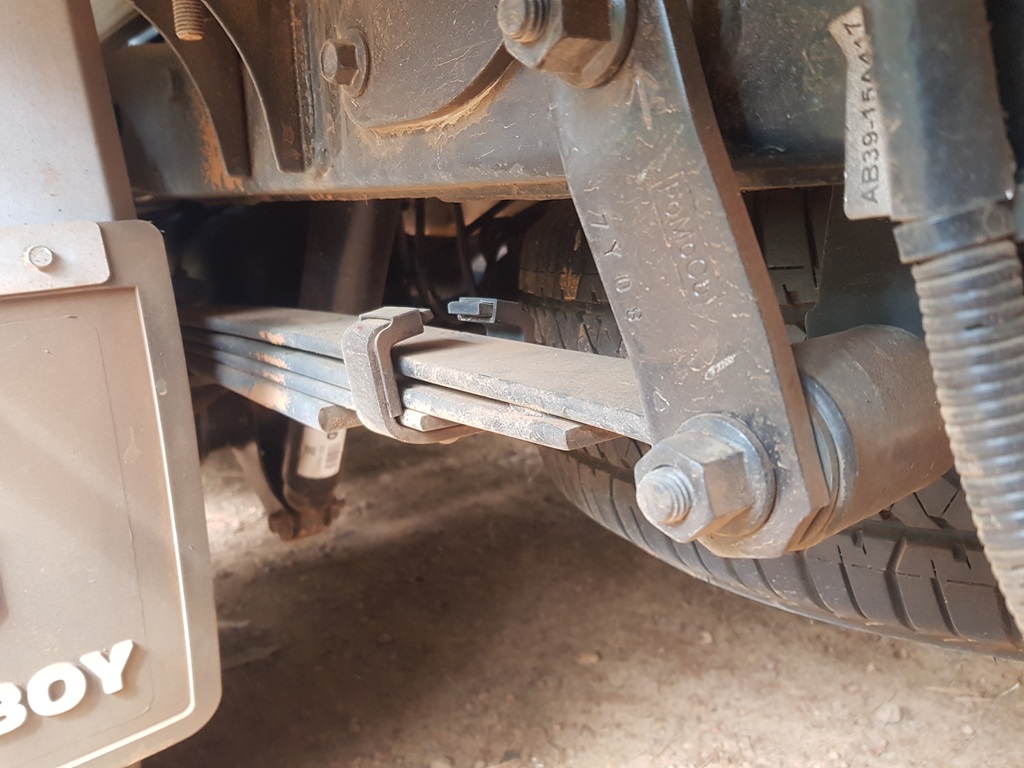
If you’re planning a serious touring trip—especially one involving corrugated roads, beach driving, or remote tracks—a GVM upgrade is often the only safe and legal option. These upgrades are certified engineering modifications that increase your vehicle’s legal weight capacity, typically by strengthening suspension, brakes, and structural components.
The Caravan: Know Your Caravan Towing Weights
Caravans have their own set of weight specifications, and understanding them is just as important as knowing your vehicle’s limits.
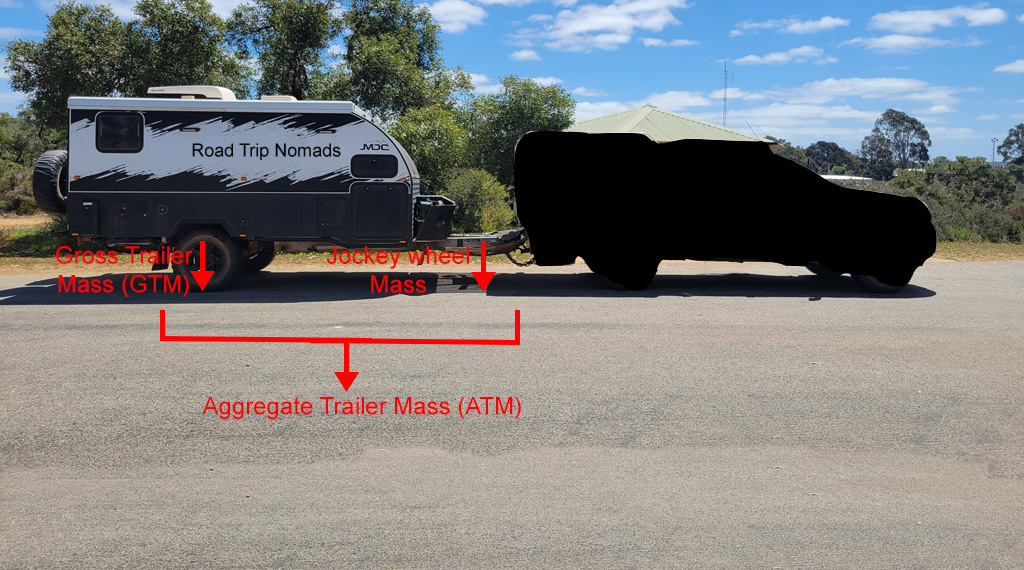
The image below illustrates the caravan weights. Near the end of the page, we put everything together when we share our weights.
Tare Weight
- Definition: The weight of the caravan as it leaves the manufacturer, with standard equipment but no personal belongings, no water in the tanks, and no gas bottles.
- The catch: Dealer-added options like solar panels, extra batteries, upgraded annexes, and air conditioning are often not included in the listed Tare weight. Always weigh the van as delivered, not as advertised.
Aggregate Trailer Mass (ATM)
Definition: The maximum the caravan can legally weigh when fully loaded and unhitched. This is the combination of the weight carried by the axle(s) and the weight on the jockey wheel.
Gross Trailer Mass (GTM)
- Definition: The maximum weight the caravan’s axles are rated to carry. This is measured with the caravan connected to the tow vehicle (hitched).
- The difference: GTM is always lower than ATM because when the van is hitched, some of its weight transfers to the car via the tow ball. GTM = ATM minus ball weight.
Caravan Payload
- Definition: ATM minus Tare. This is everything you can put into the van: clothes, food, water, gas bottles, bedding, bikes, kayaks, and all the bits and pieces of travelling life.
- Be realistic: Water is heavy—100 litres weighs 100 kg. Two 9 kg gas bottles add another 40 kg when full (including the weight of the bottles). A typical couple’s gear easily adds 200 to 300 kg. If your caravan’s payload is only 350 kg, you’re going to be making hard choices about what stays and what goes.
<INSERT DIAGRAM FOR CARAVAN adding today 4 Feb 2026>
The Connection: Tow Ball Mass and Tow Bar Limits
The coupling between your vehicle and caravan is a critical link in understanding caravan towing weights, and it has its own constraints.
Tow Ball Mass (TBM)
- Definition: The downward force the caravan exerts on the tow ball when hitched. This is typically about 10 percent of the caravan’s loaded weight for conventional caravans.
- Why it matters: TBM adds directly to your vehicle’s weight, affecting your GVM and rear axle load. It’s also limited by the tow bar itself.
Tow Bar Rating
Every tow bar has a maximum towing capacity and a maximum tow ball mass (also called the tongue weight limit). These may differ from the vehicle’s own limits, and the lowest figure always applies.
For example, your vehicle might have a manufacturer-rated tow ball mass limit of 350 kg, but if you’ve fitted an aftermarket tow bar rated to only 300 kg, that 300 kg limit is your ceiling. Always check the rating plate on the tow bar itself.
Putting it Together
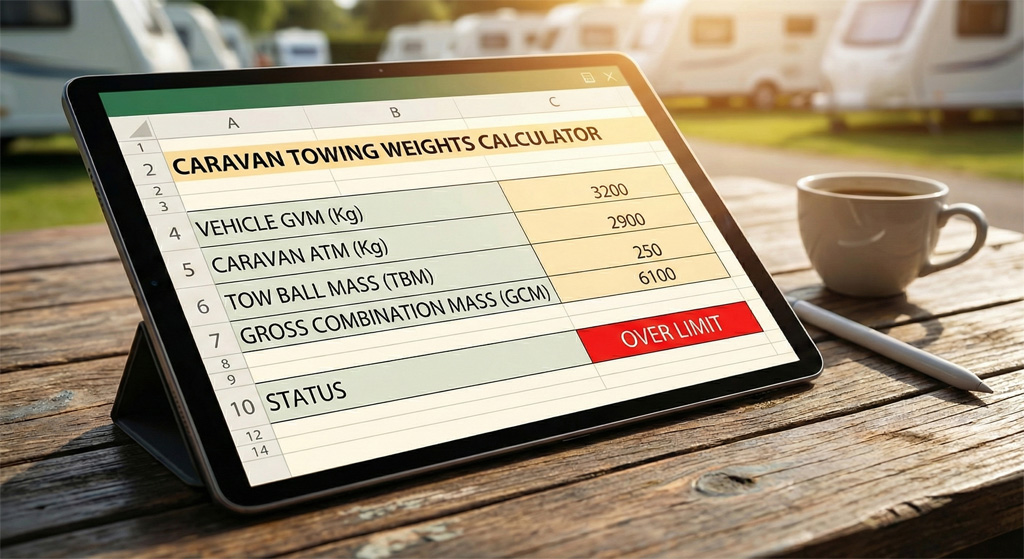
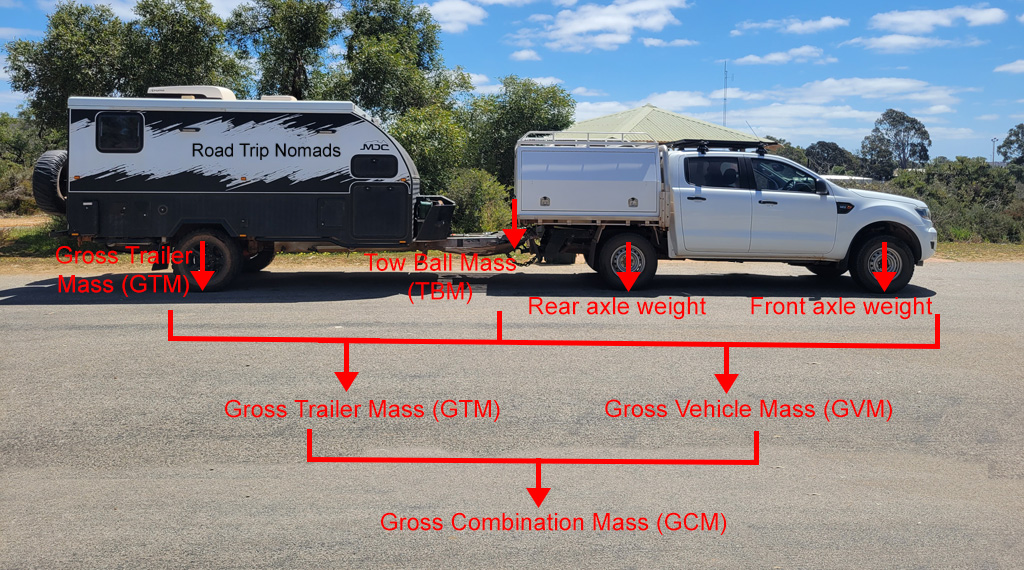
The GCM Calculation: Does it actually fit? Now that you have your Actual GVM (the loaded car) and your Actual ATM (the loaded van), you simply add them together to find your Actual GCM (see image below).
Total Weight (GCM)=Loaded Car+Loaded Caravan
The Compliance Check: This total figure must be less than or equal to the GCM rating on your vehicle’s compliance plate. If it’s over, you are illegal—even if your individual GVM and ATM numbers are perfect.
Making Caravan Towing Weights Work: Practical Strategies
Once you understand the constraints, you can work within them. Here are some approaches that experienced tourers use:
Weigh everything. Don’t guess. Take your loaded vehicle (without the van) to a public weighbridge and get actual axle weights and total weight. Then hitch the van, loaded as you’d travel, and weigh the combination. Many weighbridges can give you individual axle readings, which is gold for diagnosing where you’re carrying too much. We use Goweigh.
If you wish for a more in-depth investigation of your weights, there are dedicated caravan weighing services. These will be more accurate and can advise you if your weights exceed any limits. Towards the bottom of the page, we supply a short list of businesses that provide this service.
Lighten the van, not just the car. It’s tempting to strip gear from the 4WD to make room for tow ball mass, but if your van is heavy, address that directly. Swap steel gas bottles for aluminium. Use lightweight lithium batteries. Question whether you really need that portable generator.
Distribute weight properly in the caravan. Heavy items should sit low and over the axles, not at the front or rear. Poor weight distribution can create excessive tow ball mass or, worse, insufficient tow ball mass—leading to dangerous sway.
Does your vehicle need jewellery? This will be unpopular with some, but do you really need a big bull bar, a snorkel, underbody protection and tonnes of other stuff? These eat into your payload. We subscribe to the philosophy that no upgrades are done unless there is a demonstrated need. For example, we do not have a bull bar. The reasoning is that we only drive during the day. I worked in mining for years and have done a lot of outback driving. I have never once come close to hitting anything during daylight hours.
Consider a GVM upgrade. If you’re genuinely close to or over limits, an engineered GVM upgrade can increase your legal capacity. These aren’t cheap, but they’re a legitimate solution that keeps you legal and safe. The upgrade typically includes suspension and brake upgrades, along with a new compliance plate or sticker.
Buy a more capable vehicle. Sometimes the maths simply doesn’t work with your current car. If you’re determined to tow a particular van, you might need a vehicle with a higher GCM, better payload, or stronger rear axle rating. This is why buying the van first makes sense—you know exactly what you need from the tow vehicle.
Caravan Towing Weights Checklist for Success
Before you head off on any serious trip, work through this checklist:
- Know your vehicle’s limits. Find the compliance plate and note the Kerb Weight, GVM, GCM, front and rear axle limits, and tow ball mass limit.
- Know your caravan’s limits. Check the compliance plate for Tare, ATM, and GTM.
- Check your tow bar rating. Find the plate on the tow bar itself and note both the maximum towing capacity and the tow ball mass limit. Also, check the tongue specs.
- Do the GCM calculation. The estimated vehicle weight plus the estimated caravan weight must be under GCM.
- Visit a public weighbridge—loaded as you intend to travel. Weigh the vehicle alone (ideally getting axle weights). Weigh the combination hitched. Calculate TBM by the difference, or use a dedicated tow ball scale.
- Inspect your rear suspension. When loaded and hitched, are the leaf springs sitting flat or inverted? If so, you may be over your rear axle limit.
- Adjust or upgrade as needed. Remove unnecessary weight, redistribute loads, or investigate a GVM upgrade if you’re consistently over limits.
- Keep records. A weighbridge printout is evidence that you were legal if anything goes wrong. Some insurers may ask for it.
Professional Mobile Caravan Weighing Services
The following table includes some of the most prominent mobile weighing networks in Australia. These businesses don’t just give you a docket; they specialise in the “Alphabet Soup” of acronyms and provide educational reports to help you redistribute your load safely.
| Business | Service Area | Focus / Specialty | Contact |
| Weighbridges Australia | Australia Wide | A national network of mobile operators providing a comprehensive 5-page report. They specialize in rectifying hitch height and weight distribution issues on the spot. | 1300 011 405 |
| Weightcheck | Australia Wide | Australia’s original mobile weighing service. They offer “live load changes,” allowing you to move gear around while on the scales to see the immediate impact on your balance. | 0477 897 700 |
| Weigh Station | VIC, NSW, SA, QLD | With over 20 years of experience, they focus heavily on education and legislative compliance, ensuring you understand exactly what your numbers mean for your specific rig. | Enquire Online |
| Vanweigh Australia | WA, NSW, QLD | A highly qualified team covering major touring states. They provide a printed 9-point weight check report on-site and are members of the Mobile Weighing Association of Australia. | 0429 080 444 |
| Down Under Weighing | National Focus | Based in QLD but with a national reach, they offer expert advice on towing efficiency and safety, making them a great choice for those preparing for a big lap. | 0407 151 513 |
Why Use a Professional Service?
While a public weighbridge is great for a quick total weight check, a professional mobile service is a different beast entirely.
- Individual Wheel Weights: They check if your van is “side-heavy” (common with batteries and kitchens on one side).
- Live Adjustments: They often let you move your spare tyres or water around while on the scales to find the “sweet spot” for your tow ball mass.
- Compliance Report: You get a printed document that is invaluable for insurance purposes, proving you were operating within legal limits.
- Dual axle caravans: a weighbridge will not measure individual axle loads. Loading on both axles must be similar.
Final Thoughts on Caravan Towing Weights
Caravan towing weights aren’t exciting, and nobody gets into caravanning to spend weekends poring over compliance plates. But understanding these numbers is essential. Get it right, and you’ll have a setup that handles predictably, stops safely, and won’t attract the attention of roadside inspectors.
Get it wrong, and you’re risking your safety, your insurance coverage, and potentially your whole trip.
The weighbridge doesn’t lie. Make it your first stop before the adventure begins. It was the first stop on our two-year lap.
For coverage of other important aspects of towing, see our Caravan Guides page.